Introduction
Welcome to the future of living. If you’ve ever wished your house could think for itself—turning down the heat when you leave or locking the door you forgot about—you are ready for the world of smart home automation systems. It’s not just science fiction anymore; in 2026, it is the standard for modern, efficient living.
I remember when setting up a single smart bulb felt like a computer science project. Today, things are vastly different. The technology has matured into seamless ecosystems that prioritize convenience, energy efficiency, and security. Whether you are a tech enthusiast or someone who just wants to lower their electric bill, understanding how these systems integrate into daily life is crucial.
In this guide, I’m going to walk you through everything you need to know about building a connected home this year. We will move past the jargon and look at real-world applications that actually make life easier.
Here is what you can expect to learn:
- How automation technology has evolved by 2026
- The essential devices you need to get started
- Common pitfalls I’ve seen beginners make (and how to avoid them)
- A comparison of the top platforms available right now
Quick Overview: Smart Home Automation Systems
Smart home automation systems refer to a network of hardware, communication, and electronic interfaces that work to integrate everyday devices with one another via the Internet. These systems allow you to manage your home’s security, temperature, lighting, and appliances remotely or through voice commands, often utilizing AI to learn your habits and automate routine tasks without human intervention.
Table of Contents
- Introduction to Smart Home Automation Systems
- How Smart Home Automation Works
- Key Smart Home Automation Devices in 2026
- Benefits of Smart Home Technology
- Common Mistakes in Smart Home Automation
- How to Choose the Best Smart Home System
- Smart Home Automation for Energy Efficiency
- Real-Life Examples of Smart Home Setups
- Pros and Cons of Smart Home Automation
- Comparing the Top Smart Home Systems of 2026
- Future Trends in Smart Home Automation
- Conclusion
- Frequently Asked Questions (FAQ)
Introduction to Smart Home Automation Systems
The concept of a “smart home” has evolved rapidly. A decade ago, it was a luxury reserved for the wealthy. Now, smart home automation systems are accessible to almost anyone with a Wi-Fi connection.
In simple terms, these systems are the brain of your house. They connect various appliances and fixtures—lights, locks, thermostats—to a central network. This allows them to “talk” to each other and to you.
The history here is fascinating. We went from clunky, wired systems in the early 2000s to the sleek, wireless mesh networks we use today. Evolution has been driven by our need for three things: convenience, security, and efficiency.
In 2026, the biggest shift I’ve noticed is the integration of AI. Your home doesn’t just wait for commands anymore; it anticipates needs. It knows to turn on the lights because your car pulled into the driveway, not just because you pressed a button.
Emerging trends like IoT (Internet of Things) integration mean that even your refrigerator or washing machine can contribute to the ecosystem. It’s about creating a living space that works for you, freeing up your time for what really matters.
How Smart Home Automation Works
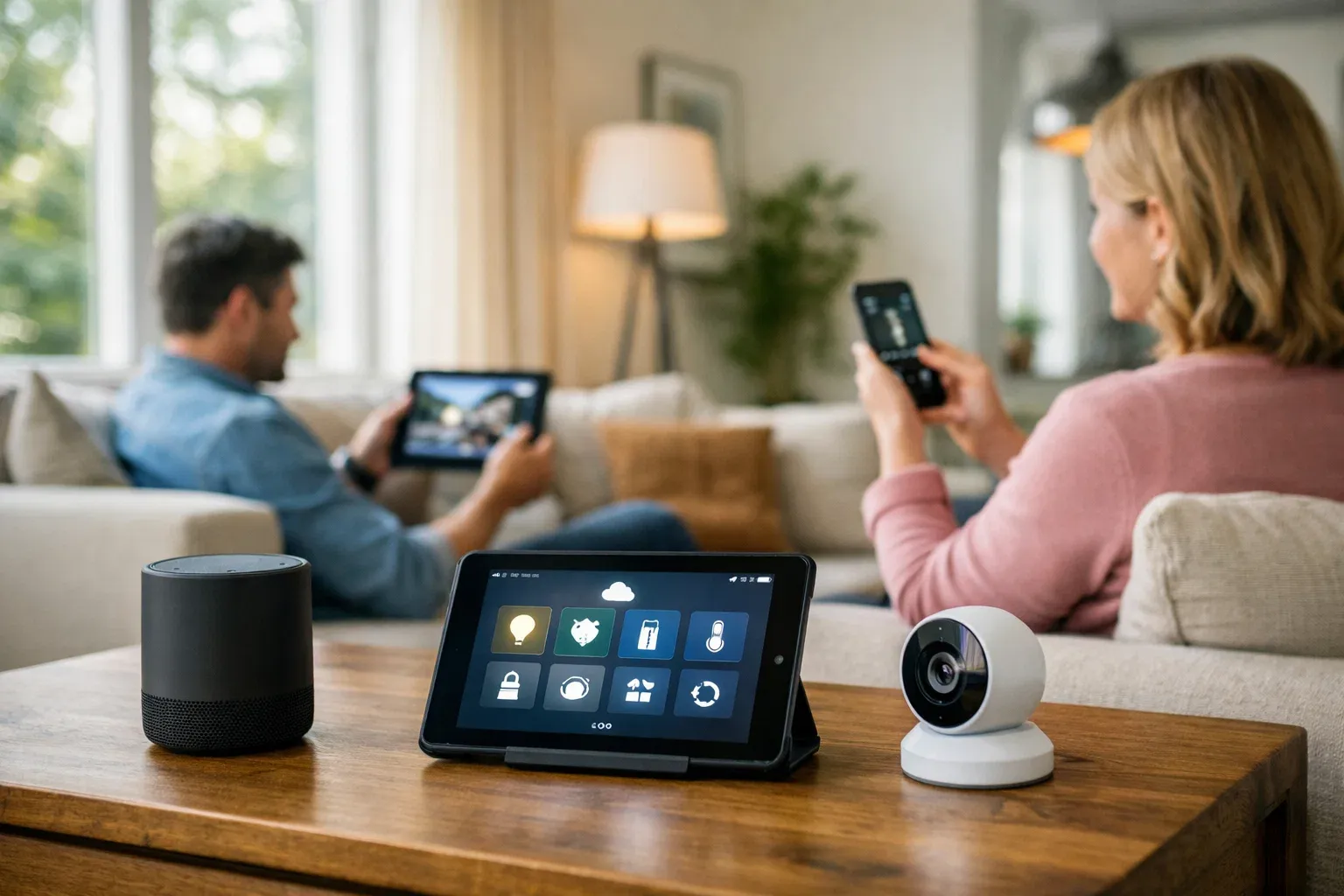
If you peel back the layers, the tech foundation is actually quite logical. It typically relies on a three-part structure: a controller (the hub), sensors, and the actuators (the devices doing the work).
The hub is the traffic cop. It sends signals to your devices. While many devices now connect directly to Wi-Fi, I’ve found that dedicated hubs often provide better stability for larger homes.
These components communicate via wireless protocols. You’ve likely heard of Wi-Fi and Bluetooth, but in the automation world, Zigbee and Z-Wave are the unsung heroes. They create a “mesh” network where devices pass signals to one another, extending the range.
The real magic in 2026 is Machine Learning. A smart thermostat isn’t just a remote control; it learns how long it takes to heat your living room and adjusts the schedule to save money.
For example, I set my system to trigger “Night Mode” at 11 PM. The AI checks if the back door is locked, dims the lights, and lowers the temperature—all without me lifting a finger.
However, connectivity brings risks. Security considerations are paramount. If a device is online, it needs to be protected, which is why understanding how these protocols encrypt data is vital for any homeowner.
Key Smart Home Automation Devices in 2026
When building your ecosystem, you need to know which home automation devices give you the best bang for your buck. The market is flooded, but a few categories remain essential.
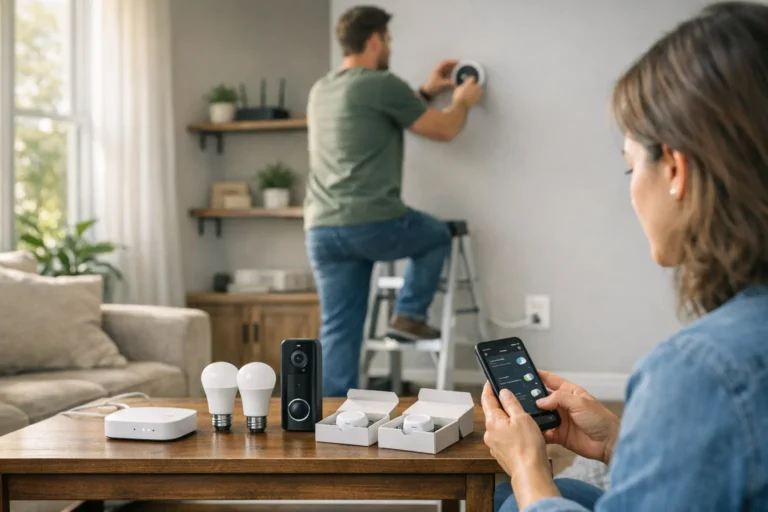
Smart lighting is usually the entry point. Whether it’s Philips Hue or budget-friendly options, being able to control ambiance and schedules from your phone is a game-changer. Motion sensors add another layer of utility here.
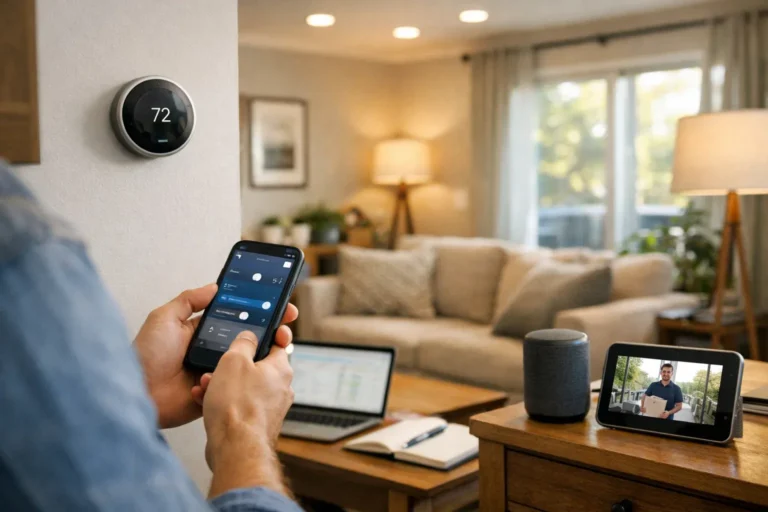
Thermostats are the next heavy hitters. Devices like the latest Ecobee or Nest models offer precise climate control. In my experience, these pay for themselves within a year through energy savings alone.
Then we have security. Smart locks allow you to grant temporary access to guests, while cameras and doorbell sensors keep an eye on your porch packages.
Voice assistants are the glue holding it all together. Whether you prefer Amazon Alexa, Google Assistant, or Apple’s Siri, these speakers act as the primary interface for voice control.
Don’t overlook smart appliances. Modern refrigerators can track expiration dates, and robot vacuums have become incredibly sophisticated, mapping your home to clean efficiently while you are at work.
Finally, integration with home entertainment systems allows for “Movie Mode” scenarios. One command can dim the lights, close the blinds, and fire up the projector.
Benefits of Smart Home Technology
Why invest the time and money? The benefits of smart home technology are tangible and immediate. The most cited advantage is energy savings.
By ensuring lights aren’t left on and heating is optimized, you reduce utility bills significantly. I’ve noticed a drop of about 15% in my monthly energy costs since fully automating my HVAC system.
Enhanced security is another massive plus. Being able to view your home cameras from halfway across the world provides peace of mind that is hard to put a price on.
Convenience is the fun part. Remote access via smartphones means you never have to wonder, “Did I leave the iron on?” You can check the smart plug status instantly.
Accessibility is a crucial, often overlooked benefit. For seniors or disabled users, voice commands can replace difficult physical tasks like getting up to turn off a switch or lock a door.
Lastly, data-driven insights are fascinating. You can monitor exactly how much energy your dryer uses or how often the front door is opened, helping you make better decisions about your household habits.
Common Mistakes in Smart Home Automation
I have made plenty of mistakes over the years, so you don’t have to. The biggest error is overcomplicating the setup. Buying fifty devices without a central plan or hub often leads to a digital mess.
Ignoring compatibility is another classic blunder. Not all smart home automation systems play nice with each other. Buying a camera that doesn’t work with your smart display is a frustrating waste of money.
Security practices are often too lax. Many people leave their devices on default passwords. This is akin to leaving your front door wide open. Always change the default login details immediately.
Poor Wi-Fi coverage is a silent killer of automation. If your smart bulb is in a dead zone, it won’t respond. I always recommend a mesh Wi-Fi system if you plan to automate a larger home.
Lastly, failing to update firmware is risky. Manufacturers release updates to patch security holes and improve performance. Ignoring these notifications can leave your network vulnerable.
How to Choose the Best Smart Home System
Selecting the right platform is the most critical decision you will make. You need to weigh factors like budget, the size of your home, and your technical comfort level.
There is a debate between single-brand ecosystems and mixed setups. Staying within one brand (like purely Google Nest products) is easier, but mixed setups often offer better individual devices.
Evaluate the app interfaces. You will be using this app every day. If it is clunky or slow, you will resent your smart home. Read reviews specifically about the app’s usability.
Customer support is vital. When a smart lock jams or a camera goes offline, you want a responsive support team. Check reliability ratings and user forums before buying.
For an apartment, a simple Wi-Fi-based system with a few bulbs and a speaker is ideal. It requires no wiring and is easy to move.
For a large family home, a robust hub-based system (like Samsung SmartThings or Hubitat) is better. It can handle dozens of devices without clogging up your Wi-Fi bandwidth.
Smart Home Automation for Energy Efficiency
One of the most compelling reasons to adopt this tech is sustainability. Automation takes the human error out of energy conservation.
Smart thermostats are the heroes here. They don’t just hold a temperature; they learn your schedule. They heat the house only when you are actually there, cutting down on waste.
Lighting automation goes beyond just timers. Paired with motion sensors, lights in hallways or bathrooms turn off automatically when no one is in the room.
Smart plugs are excellent for “vampire devices.” These are appliances that suck power even when in standby mode. A smart plug can cut power to your entertainment center completely at night.
In 2026, solar energy integration is seamless. Smart monitoring systems can tell you exactly how much power your panels are generating and switch high-load appliances to run during peak sunlight hours.
For sustainability-conscious homeowners, this isn’t just about saving money. It is about reducing your carbon footprint through intelligent management of resources.
Real-Life Examples of Smart Home Setups
Let’s look at how this plays out in the real world. I recently visited a family home that was fully automated for security.
They had sensors on every window. If a window opened at night, the lights would flash red, and a siren would sound. It gave them immense peace of mind living in a busy area.
Conversely, I’ve seen urban apartments focused purely on efficiency. A friend uses just three smart plugs and a thermostat. She controls her coffee maker, space heater, and AC from her bed. Simple, but effective.
Smart homes for elderly users are incredibly touching. I know a family that set up voice-activated calling and automated lighting for their grandmother, allowing her to live independently for years longer than expected.
The remote work setup is another popular trend. My home office automatically adjusts the lighting temperature to “cool white” for focus during work hours and shifts to “warm white” at 5 PM to signal the end of the day.
The lesson from these users is consistent: start small. solve one problem at a time, rather than trying to automate the whole house in one weekend.
Pros and Cons of Smart Home Automation
It is important to have a balanced view. While I am an advocate, smart home automation systems are not perfect.
Pros:
- Convenience: Managing your home from a phone is undeniably great.
- Energy Savings: The systems eventually pay for themselves.
- Security: Better monitoring capabilities.
- Remote Access: Control your home from anywhere.
Cons:
- Cost: The initial investment for a comprehensive system is high.
- Complexity: Troubleshooting connection issues can be annoying.
- Privacy: You are trusting companies with data about your lifestyle.
- Dependency: If the internet goes down, some devices lose functionality.
It comes down to your tolerance for troubleshooting vs. your desire for convenience. For most, the pros far outweigh the cons.
Comparing the Top Smart Home Systems of 2026
If you are looking for the best smart home systems, the market is dominated by a few giants. Here is how they stack up in 2026.
Amazon Alexa remains the leader in compatibility. Almost every third-party device works with Alexa. It is affordable and easy to set up, making it great for beginners.
Google Home shines in intelligence. Its integration with Google Search and Maps makes it incredibly helpful for information. The interface is clean, though it supports slightly fewer devices than Alexa.
Apple HomeKit is the gold standard for privacy and security. If you are already in the Apple ecosystem, this is the logical choice. However, compatible devices tend to be more expensive.
Samsung SmartThings is for the power user. It offers incredible automation depth. You can create complex rules that other systems just can’t handle, but it has a steeper learning curve.
For a non-technical user, I usually recommend Alexa or Google. For someone concerned with data privacy, Apple is the winner. For the hobbyist who wants total control, go with SmartThings.
Future Trends in Smart Home Automation
What does the future hold? We are moving toward predictive automation driven by AI. Your home will eventually stop asking you what to do and just do what you want.
Integration with health devices is the next frontier. Imagine your smart home lowering the blinds and playing white noise because your smartwatch detected your stress levels are high.
Voice and gesture control are getting sharper. We are seeing technology that allows you to point at a light to turn it on, bypassing voice commands entirely.
Cybersecurity is becoming a major product feature. We will see more “local control” hubs that process data in your house rather than sending it to the cloud, improving privacy.
Finally, Matter (the interoperability standard) continues to improve. The goal is a world where you never have to check “does this work with my system?” because everything will just work together.
Conclusion
Navigating the world of smart home automation systems in 2026 can feel overwhelming, but the destination is worth the journey. These systems have transformed from novelty gadgets into essential tools that make our lives safer, more efficient, and undeniably more comfortable.
In my experience, the key is to not rush. Start with a smart speaker and a few bulbs. Get comfortable with the app. Then, expand to thermostats and security as you understand your own needs better.
Remember, the “best” system isn’t the most expensive one; it’s the one that solves your specific problems. Whether that is saving on heating bills or making sure the front door is locked at night, the technology is here to serve you.
Key Takeaways:
- Start simple to avoid technical burnout.
- Prioritize security by changing default passwords immediately.
- Focus on devices that offer real value, like smart thermostats.
- Choose an ecosystem (Alexa, Google, Apple) and stick to it for simplicity.
Assess your budget, pick your first device, and step into the future of living.
Frequently Asked Questions (FAQ)
What is a smart home automation system and how does it work?
A smart home automation system connects various devices in your home to a central network, usually via Wi-Fi. It allows you to control things like lights, locks, and thermostats remotely through an app or voice commands. The system works by sending signals between a central hub (or your phone) and the connected devices to execute tasks.
Which devices are essential for a basic smart home setup?
For a solid foundation, I recommend starting with a smart speaker (like an Echo or Nest Audio), a few smart bulbs, and a smart plug. These give you voice control over lighting and small appliances. Once you are comfortable, a smart thermostat is the best next step for added value.
How much does it cost to install a smart home system?
The cost varies wildly. You can start a basic setup for under $100 with a speaker and a couple of bulbs. A comprehensive system for a whole house—including cameras, locks, and sensors—can easily range from $1,000 to $3,000 depending on the quality of the devices.
Can I mix devices from different brands?
Yes, you absolutely can, and most people do. However, you need to ensure they are compatible with your central platform (like Alexa or Google Home). The industry standard “Matter” has made mixing brands much easier in recent years, but always check the box for compatibility logos.
Is smart home automation safe and secure?
It is generally safe, provided you take precautions. The risks come from weak passwords and outdated software. To stay secure, use unique, strong passwords for your accounts, enable two-factor authentication, and keep your router and device firmware updated.
How can I save energy using smart home technology?
Smart thermostats are the biggest energy savers; they adjust heating and cooling based on whether you are actually home. Smart lights prevent electricity waste by turning off automatically when rooms are empty. Smart plugs can also cut power to devices that drain energy in standby mode.
What’s the easiest smart home system to set up for beginners?
In my experience, Amazon Alexa is the most user-friendly for beginners. The app is intuitive, and the setup process for new devices is very straightforward (“Alexa, discover my devices”). Google Home is a close second and is excellent if you already use Android phones.
About the Author